Why PTSD and Chronic Pain Coexist After a Car Accident
This visual symbolizes the physical manifestation of invisible trauma: chronic muscle bracing. (Image: AI-generated)
A motor vehicle accident is a violent disruption of safety that the body does not easily forget. While modern medicine is excellent at patching up broken bones and stitching lacerations, the most profound injury often occurs within the nervous system.
Post-Traumatic Stress Disorder (PTSD) is not merely a psychological struggle; it is a physiological rewiring. When a collision occurs, the brain’s emergency response system—the sympathetic nervous system—is flooded with high-octane neurochemicals designed for survival.
In many cases, the "off switch" for this response becomes jammed. This state of persistent neurological high alert creates a fertile ground for chronic pain to take root, turning a temporary injury into a long-term struggle.
The Brain’s Broken Volume Knob
One of the most critical reasons pain persists after an accident is a process called Central Sensitization.
Imagine the pain signaling system in your body as a radio. In a normal state, the volume is adjusted based on the level of actual tissue damage. However, PTSD acts like a broken volume knob that is stuck at the highest setting. Because the brain remains in a state of hyper-vigilance, it begins to amplify every signal coming from the body.
Even after the inflammation from a whiplash injury has subsided, the brain continues to perceive "danger," resulting in a persistent, aching sensation that MRI scans cannot explain.
This is why many survivors feel "crazy" when doctors tell them their scans are clear, yet their daily pain remains debilitating.
Understanding PTSD
PTSD is often misunderstood as purely an "emotional" reaction, but in the context of a car accident, it acts as a psychological blueprint for chronic physical pain. When you experience a traumatic collision, your brain doesn't just record the event as a memory; it archives it as a survival threat.
For survivors with PTSD, the brain remains trapped in a loop of "re-experiencing."
This means that even when you are sitting safely at home, your brain perceives the environment as if another crash is imminent. This constant mental state of Hyper-vigilance has direct physical consequences:
Adrenal Exhaustion
The continuous release of cortisol and adrenaline keeps your muscles in a state of "pre-impact" tension, leading to profound systemic fatigue.
The Avoidance Cycle
PTSD often causes survivors to avoid driving or even moving in ways that remind them of the accident. This lack of movement leads to joint stiffness and muscle atrophy, which ironically increases the very pain they are trying to avoid.
Emotional Flashbacks & Muscle Memory
Sometimes, a sudden loud noise or a sharp turn in a car can trigger a "body flashback," where your muscles instantly seize up in the exact same pattern they did during the original accident.
The Muscle Bracing Loop and Myofascial Pain
During the split second before a car crash, the human body instinctively "braces" for impact. Muscles in the neck, shoulders, and lower back contract with incredible force to protect the spine.
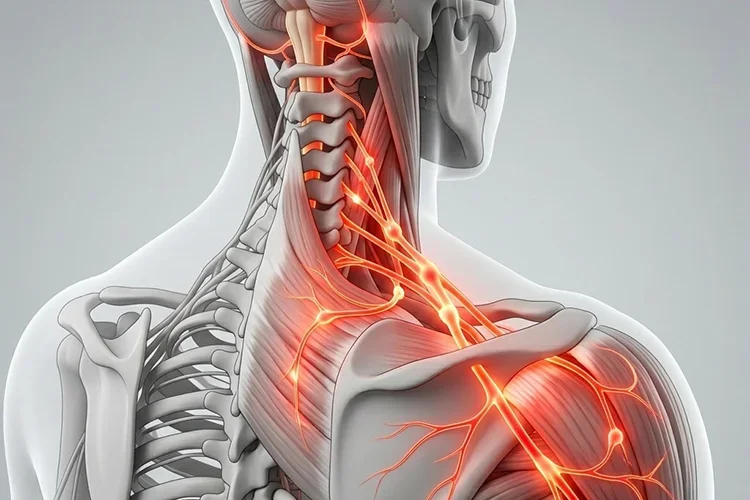
This visual illustrates how chronic muscle tension is driven by persistent neurological signals and an 'overloaded' nervous system, rather than local tissue damage alone. (Image: AI-generated)
For an individual dealing with PTSD, the brain remains convinced that another impact is imminent. This leads to chronic muscle bracing—a state where your muscles never truly reach a state of rest, even while you sleep.
Oxygen Deprivation in Tissue
Constant contraction squeezes the capillaries, reducing blood flow and oxygen to the muscles, leading to the formation of painful trigger points.
Postural Distortion
Chronic tension in the upper trapezius and levator scapulae muscles alters your posture, which then creates secondary pain in the jaw (TMJ) and lower back.
Metabolic Waste Buildup
Without the "pump" of muscle relaxation and contraction, metabolic byproducts like lactic acid build up in the tissue, causing that heavy, burning ache familiar to many accident survivors.
The Role of the Vagus Nerve in Recovery
The Vagus nerve is the "brake pedal" of your nervous system, responsible for the "rest and digest" state.
In the aftermath of a traumatic accident, this nerve's function can become suppressed. When the Vagus nerve isn't working effectively, the body cannot enter the parasympathetic state required for cellular repair and inflammation reduction. This is why survivors often experience digestive issues, heart palpitations, and shallow breathing alongside their chronic back pain.
High-quality rehabilitation must look beyond the spine and consider how to "tone" the Vagus nerve to signal to the entire body that the threat has passed.
Identifying the Symptoms of Trauma-Induced Pain
Understanding the overlap between physical and emotional symptoms is key to tailoring a successful recovery plan.
You may notice that your physical symptoms are intricately tied to your psychological state in the following ways:
The "Startle" Flare-up
A loud noise, a car horn, or a sudden movement causes an immediate, sharp spike in your neck or back pain.
Hyper-Vigilance Fatigue
The mental energy required to constantly scan your environment for danger leaves your body with zero resources for tissue healing, resulting in profound, systemic exhaustion.
Emotional Anchoring
Pain flares up not because you moved wrong, but because you passed the intersection where the accident occurred or had to fill out insurance paperwork.
Dissociation from the Body
Some survivors feel "disconnected" from the pained area, making it difficult to perform standard physical therapy exercises correctly because the brain is trying to ignore the traumatized region.
Breaking the Cycle: A Multi-System Approach to Healing
Traditional physical therapy often focuses on the "hardware"—the muscles and joints.
However, for a survivor with PTSD, we must also address the "software"—the neurological pathways.
A truly effective recovery plan involves neurological stabilization.
This includes manual therapies that soothe the nervous system, breathing re-education to shift the body out of "fight or flight," and graded motor imagery to retrain the brain's perception of the injured area.
When we treat the whole person—acknowledging that the memory of the crash is held in the tissues as much as in the mind—we open the door to a level of healing that surgery or medication alone cannot achieve.
This post is for educational purposes only. Please read our full Medical Disclaimer here.