Ringing Ears or Feeling Anxious After a Car Accident? Understanding Your Body’s Hidden Signals
Invisible symptoms after a car accident can significantly impact your daily quality of life. Credit: Vitaly Gariev / Unsplash
After experiencing the shock of a car accident, your body sends signals in various ways. While visible pain in the neck or back is easy to notice, strange sounds in your ears or anxiety that keeps you awake at night can leave you feeling uncertain about where to seek help.
Many adults between the ages of 30 and 65 often dismiss these symptoms as signs of aging or temporary fatigue. However, it is vital to remember that psychological changes and tinnitus appearing after a collision are significant indicators that your nervous system may have sustained a physical impact.
The shock your body receives during an accident travels much deeper than you might think. Even if there is no bleeding or broken bones, the delicate network of nerves within your body can remain in a state of alarm due to the sudden jolt. If this state is not addressed in a timely manner, your body continues to maintain a high level of tension, which eventually manifests as the various uncomfortable symptoms you experience.
The Impact of Collision Force on the Nervous System and Ears
The sudden acceleration and deceleration during a car accident transmit strong rotational forces to the head and neck. During this event, delicate nerves and blood vessels around the neck can become irritated, which may disrupt the signal system sent to the brain. Because the nerves controlling balance and auditory signals pass closely through the cervical spine area, even a minor change in spinal alignment can lead to the ringing in the ears known as tinnitus.
This is often not a structural problem within the ear itself but rather a result of neurological pressure or interrupted blood circulation originating from the neck. Therefore, checking only the ears may make it difficult to find the cause, and an integrated approach that examines the condition of the neck and the flow of nerves is necessary. Instead of focusing solely on eliminating the sound, the key to treatment is understanding why the nerves have become sensitized.
Psychological Changes Driven by Autonomic Nervous System Imbalance
The human body naturally flips an "emergency switch" to protect itself during crises like an accident. Your heart beats faster, your muscles tighten, and you become extremely sensitive to your surroundings. The problem arises when this emergency switch fails to turn off after the event has concluded and the situation is over. Feelings of palpitations or fear of getting back behind the wheel without a clear reason are absolutely not signs of weak willpower.
These are states where the nervous system, sensitized by the accident, is overreacting, making it essential to undergo a process to return it to a calm state. This nervous system tension often does not resolve on its own over time, and it is only through a proper rehabilitation process—sending signals back to the brain that the body is safe again—that a return to daily life becomes manageable.
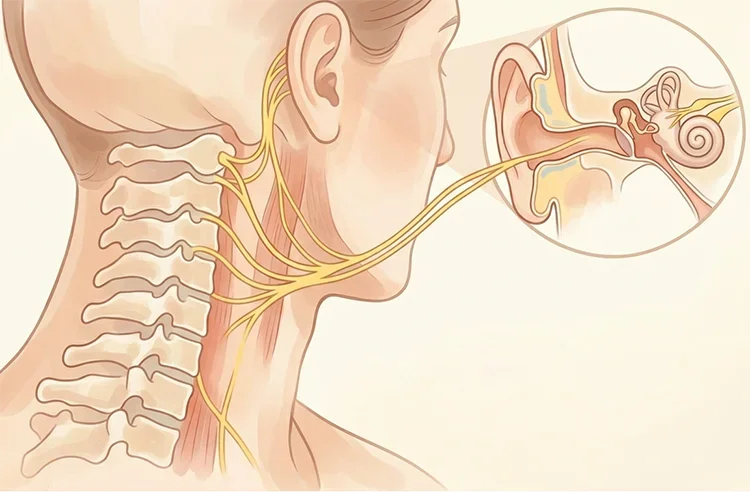
A diagram illustrating the connection between neck nerves and the inner ear. It visually explains how the force of a collision on the neck can lead to symptoms like tinnitus or dizziness. (AI-generated)
Practical Steps to Support Your Recovery
Small habits practiced in daily life can be of great help in stabilizing your nervous system. It is better to focus on relaxing your body rather than engaging in strenuous exercise.
First, taking a warm shower or applying heat packs daily to relax the stiff muscles around the neck and shoulders is effective in reducing pressure on the nerves. Additionally, before bed, dimming the lights and reducing smartphone use creates an environment where the brain can rest. Cutting back on caffeine also helps soothe sensitized nerves. Practicing light walks or deep, repeated breathing is an excellent way to slowly lower your body's tension levels.
Systematic Approaches for Neurological Recovery
Methods that encourage the body's natural recovery capacity are often much more effective than surgical interventions for resolving tinnitus or anxiety. Rather than trying to force a fix, manual care that realigns the neck to create a comfortable path for nerves, or methods that lower inflammation to calm nerve excitation, play a positive role.
Furthermore, personalized rehabilitation exercises—starting with very basic movements to gradually strengthen areas weakened by the accident—do more than just build muscle. They are a crucial process for retraining our bodies to accept external stimuli normally again. Through this process, the nervous system gradually finds stability, and the noise in the ears or the anxiety in the heart will naturally subside.
Healthy Recovery from a Long-Term Perspective
Ignoring small signals from your body just because the current pain is bearable could lead to greater discomfort appearing unexpectedly as time passes. Especially after the age of 30, the body's recovery speed is not what it used to be, making it the wisest choice to find the exact cause at an early stage. The anxiety and physical suffering experienced after an accident are not just "in your head" but are real symptoms stemming from physical damage.
Returning to a healthy daily life requires systematic care that addresses even the invisible parts of an injury. Rather than delaying while worrying alone, objectively checking your current status and seeking appropriate help is the fastest way to recover. Please listen a little more closely to the small signals your body and mind are sending right now.
This post is for educational purposes only. Please read our full Medical Disclaimer here.